Team-manager relationship : towards a new dynamic
Linking organisational progress and human progress : Meeting the challenges of complexity and uncertainty depends on this dual progress. It starts on the ground, where experience, skills and exchanges are confronted daily with real work situations.
Beyond the practices required for operational effectiveness, the quality of human relationships becomes a key condition for progress. Organisations play a role in creating the conditions that allow these relationships to grow and last. This perspective also invites us to rethink the manager’s position. Managers are no longer simply positioned in front of their teams, but take their place within them, as part of a new collaborative dynamic.
Towards a new Team-Manager relationship – Progress in the field where work happens
Let’s think back to 2020. Covid disrupted the way we worked and interacted. Faced with this unprecedented adversity, technology provided new solutions, while human relationships brought them to life: mutual support, solidarity, sharing experiences and inventing new ways of working. We faced a shared challenge: to carry on working whilst integrating work into our private lives, and creating closeness despite physical distance.
Faced with our own difficulties, we found the energy to support others and contribute to collective solutions. We committed ourselves to the collective, which in turn supported us. This period, also marked by isolation and stress, highlighted an essential capacity : When faced with an unfamiliar situation, we can move beyond our individual perspectives to build collective responses to uncertainty.
What about that collective energy today ?
The virus created a common threat that affected both our organisations and our homes. Today, the situation is different. Faced with continuous change, organisations need to mobilise their strengths. Yet people, repeatedly called upon to respond to successive transformations, do not all show the same readiness to do so. Mental strain has increased, a sense of weariness may have set in and, with it, a possible sense of disillusionment about what progress at work might still mean.
The experience of Covid nevertheless taught us that the collective is not simply a way of coping with difficulties. It can also become a space where new responses are developed and each person’s capabilities can grow.
But how far can we ask people to adapt to complexity and uncertainty ?
Imagine a manager facing new performance demands, technological changes and rising absenteeism, all at the same time. Pressure is mounting for everyone. New employees are expected to settle in at a pace that leaves little room for their learning curve, while established teams absorb the changes and maintain performance. Gradually, fatigue creates tensions, and attention increasingly shifts towards the difficulties people are experiencing.
How does the organisation respond ? It may help managers and employees manage stress more effectively, strengthen their ability to adapt or develop resilience. But how much more adaptation can reasonably be expected of people ? We may have all the necessary skills and yet no longer have the energy to put them fully into practice.
Adaptation then reaches its limits and can become over-adaptation. The individual is the first to bear the consequences. For the organisation, however, over-adaptation can never be a sustainable response to performance demands.
What If we reversed the logic ?
Rather than continually asking people to adapt, what if we considered how organisational progress could drive human progress ? This perspective applies at every level: from strategic decision-making to governance, culture, management, organisational structures and working practices.
From the outset, we need to consider how to meet the demands of work while preserving a healthy balance and developing the resources needed to function sustainably. We know that people seek meaning, find interest in their work and want opportunities to grow. The organisational progress we are considering here involves creating a dynamic that renews energy, develops capabilities and nurtures both individual and collective commitment.
The field : Where organisational and human progress happen
In the field, situations take shape and difficulties become visible. We see the gaps between what was planned and what actually happens. This is also where people experiment, adjust their practices, detect early warning signs and develop new knowledge.
Whoever does, knows, yet no one necessarily knows enough to act alone : complexity goes beyond the individual. The shift towards greater cooperation and cross-functional working already represents a key asset in addressing the challenges of complexity. Yet working practices need to evolve further towards collective intelligence. This capacity is built through the quality of exchanges, the sharing of knowledge and ideas, the comparison of experiences and the diversity of perspectives.
Collective intelligence is rooted in shared emotional experiences : The pleasure of working together, support through difficulties, tensions overcome and pride in common challenges met. These experiences strengthen relationships, interest and motivation. They generate a collective energy that helps people face difficulties without placing additional demands on individual resources. It sustains lasting commitment, encourages learning and helps develop new responses to complexity.
Team and Manager : Bringing two sources of potential together
With the aim of fostering progress in the field, we still consider two essential sources of potential separately : the team and the manager.
In a widely held view of management, the manager :
Problems are still often escalated to the manager, who is expected to provide the answers. These responsibilities remain necessary. However, this managerial approach reaches its limits when situations evolve rapidly, present unprecedented complexity and solutions are no longer known in advance.
Each one holds part of the potential needed to address complexity : The team through its direct knowledge of real work situations, the diversity of its experiences and skills; the manager through a broader perspective, their responsibilities and the connections they establish across the organisation. Bringing these two sources of potential closer together can expand their capacity to respond.
The manager’s changing position within the team
Moving within the team does not mean that the manager loses their role or takes on less responsibility. It means taking different positions within the team’s working dynamic, depending on the situation. The manager may set the direction and make decisions. They may also work with the team to develop solutions, question and challenge ideas, or step back to create space for reflection and proposals. In doing so, the manager also learns from the team.
The managerial question then becomes : What position should I take in this situation to best contribute to our collective capacity to respond ? This shift opens up broader collaboration between the team and the manager. It is no longer about passing information up and down: it is about making it flow.
Observations, experiences, questions and initiatives are thus brought into circulation. They are challenged, enriched and connected. While remaining responsible for the framework and direction, the manager is no longer necessarily the point towards which all answers must converge. They become an active part of this system of exchanges.
Bringing the team and manager closer together is not only about how they work together. It also transforms their relationship and the way they perceive one another. By sharing more of the reflection around situations, the team gains a better understanding of the challenges, constraints and trade-offs the manager faces. In turn, the manager becomes more closely connected to the team’s experiences and realities. Responsibilities and decision-making authority remain different, but mutual understanding grows. This closer relationship strengthens the capacity to respond operationally while also transforming the human relationship between team and manager.
New behaviours to embed circular collaboration
In order to achieve real progress in how work is carried out in the field, circular collaboration also requires new behaviours. Everyone needs to be able to take their place differently, developing new ways of relating to others.
“Circularity” begins with autonomy built through interdependence : exercising one’s judgement, taking initiative, testing one’s reasoning against other perspectives, while knowing when to draw on others’ resources and recognising one’s own limitations.
Interdependence, in turn, brings greater reciprocity. The manager retains their specific responsibilities : setting direction, making decisions, providing support, giving feedback and recognising contributions. But they also listen, ask questions, encourage ideas to emerge and learn from the team. Team members develop their judgement, their ability to challenge ideas and their sense of responsibility within the collective. They become more active contributors to reflection, learning and developing responses through this broader collaboration with the manager.
This is how progress in the team–manager relationship is built : greater autonomy without independence, greater reciprocity without blurring roles, and greater responsibility in building collective responses.
In search of a new collaborative maturity
Changing behaviours also calls for a new form of maturity at work. This maturity shapes each person’s ability to engage with others while remaining receptive to what they bring.
This maturity enables everyone to better understand their role and scope of responsibility. Each person feels able to take action, exercising their own judgement without constantly seeking approval from authority. We learn to challenge one another, accepting disagreement and different perspectives. The focus shifts towards the quality of how we work together.
This maturity allows the manager to acknowledge that they do not know without losing their legitimacy. Team members can move forward without expecting the manager to provide reassurance for every decision they make. Each recognises what the other can contribute and sees them as someone with whom responses can be developed.
The organisational potential we need no longer lies solely in what individuals possess separately. It also lies in what becomes possible when an organisation brings people closer together, connects their capabilities and supports their development through action. In doing so, the organisation develops the collective capacity to build responses it does not yet have.
Organisational progress and human progress are no longer two separate goals to pursue: they reinforce one another within a shared dynamic of development.
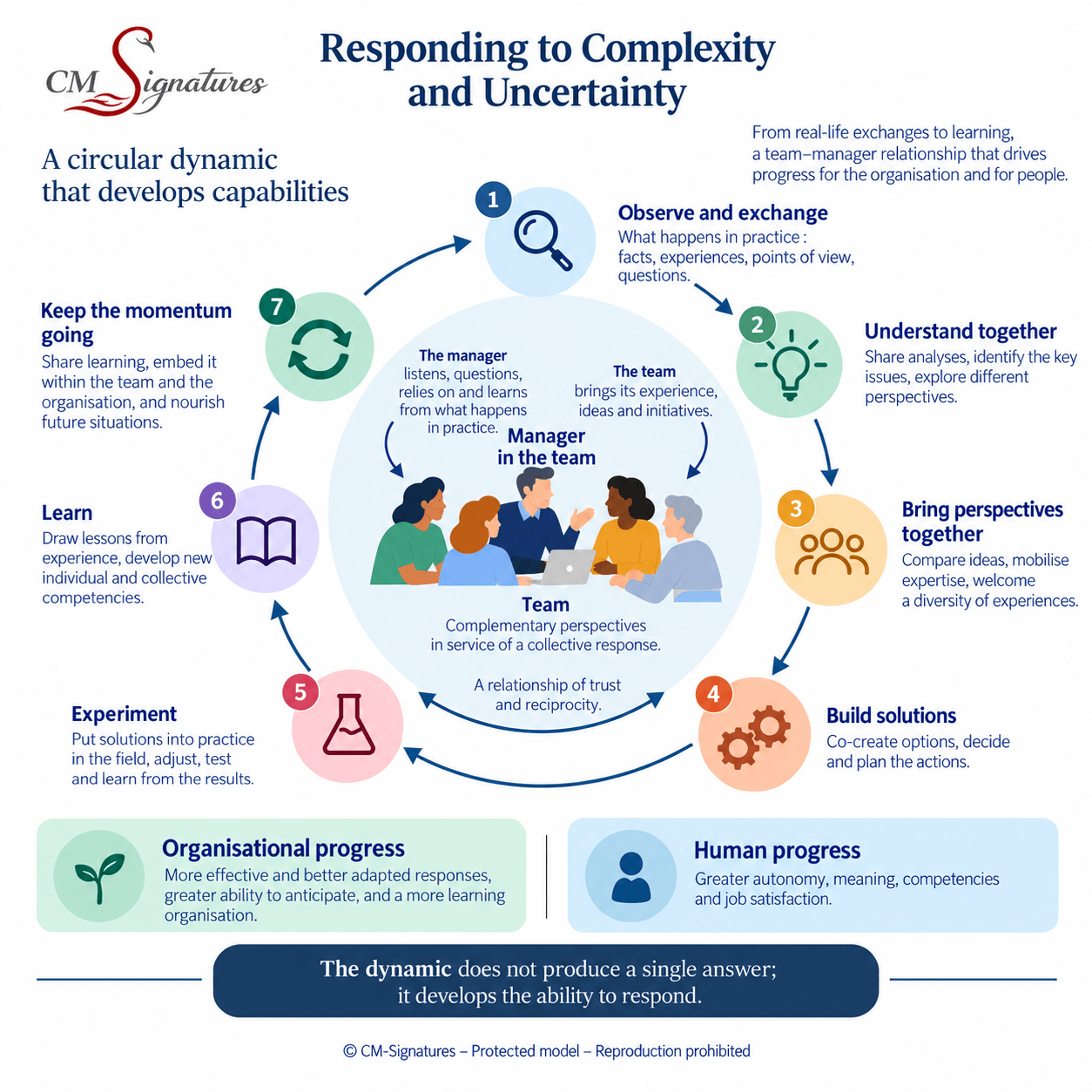
Going further
The circular dynamic of organisational progress, together with the human development that supports it, requires the right conditions to be established from the outset. This starting point deserves further exploration. It requires an understanding of how people function at work, particularly during periods of change and when facing the challenges of complexity and uncertainty.
Your turn : Put it into practice – Moving within the team as a manager
At your next team meeting, consider which position would best meet the needs of the situation (or which different positions might be appropriate at different moments) :
Perhaps the question is no longer: “Does my team need me to provide the answers ?”
But rather: “How can I contribute to developing our collective capacity to build the answers ?”
Managerial skills to develop
Would you like to develop your managerial approach and strengthen your team dynamics ?
Discover Signature Management, our programme for managers and senior executives.
© 2026 Chantal Marino – CM Signatures. All rights reserved.